
-
Video Fingerprinting vs. Watermarking: Key Differences

Fingerprinting detects stolen live streams fast; watermarking traces leaks to specific users or sessions.
-
How Multimodal Content Matching Scales with AI

AI-driven multimodal matching, vector search, and fingerprints enable fast, scalable content protection and verifiable ownership.
-
Multimodal Content Matching for Digital Piracy

Multimodal matching, watermarking, and timestamped ownership records detect and enforce against cropped, remixed, or reuploaded pirated media.
-
Customizing Evaluation for Domain-Specific Frameworks

Evaluation must mirror real risk: map goals to clear metrics, test with production-like edits, log runs, and track repeat reliability.
-
AI in Action: Fighting Subtitle Piracy

Multimodal AI—OCR, ASR, NLP—plus watermarking and blockchain timestamps to detect, trace, and prove subtitle theft.
-
Multimodal Similarity for Content Protection

Detect edited UGC by combining visual, audio, and text similarity with invisible watermarking and blockchain timestamps.
-
How Multimodal AI Powers Content Protection
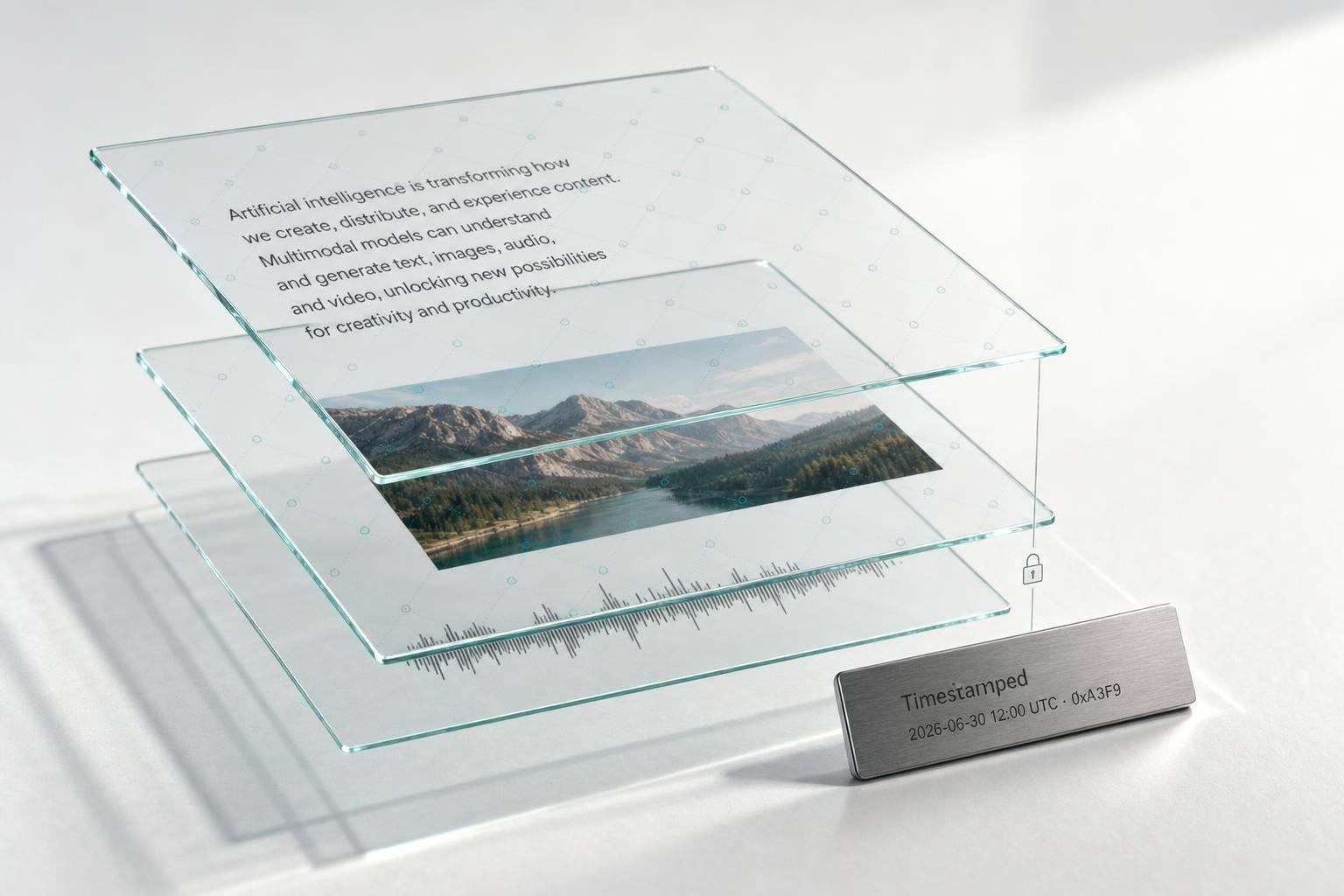
Multimodal AI, fingerprinting, watermarking, and blockchain timestamps detect cross-format reuse, prove ownership, and speed takedowns.
-
Scaling Multimodal AI for High-Volume Media Matching

Build shared embeddings, segment video, and use optimized vector search for fast, accurate media matching and enforceable ownership records.
-
5 Privacy Risks in Multimodal Content Matching

Five core privacy threats in multimodal content matching—identity linkage, biometrics, profiling, model leakage, and consent failures, with practical fixes.
-
5 Challenges in Multimodal Content Matching

Breaks down five core barriers—heterogeneous modalities, alignment, fusion, transformations, and scale—to reliable cross-format content matching.